Following an education forum held in Tashkent on September 8, Uzbekistan’s Minister of Preschool and School Education, Ezozkhon Karimova, addressed journalists’ questions and commented on the preliminary results of the PISA 2025 study. According to her, the results demonstrate an improvement in students’ knowledge, yet a number of unresolved issues remain in the education system.
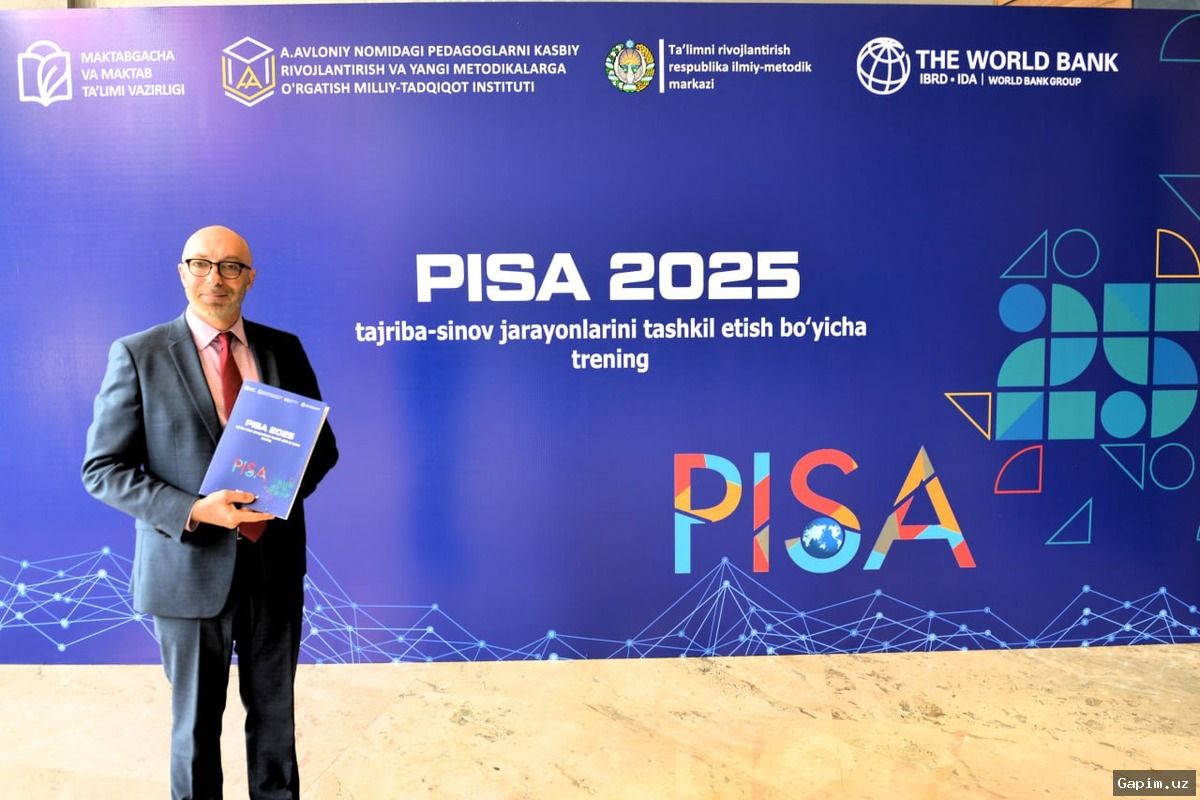
Karimova stated that the PISA study examined students’ knowledge in natural sciences, the conditions created in schools for their learning, and several other aspects. The results showed that Uzbekistan holds a high position among Central Asian countries. The minister also outlined the areas that require attention in the next stage. She noted that greater emphasis will now be placed on students’ ability to apply the knowledge they acquire in a scientific direction. She assessed this as one of the main tasks facing the education system. “Our children are acquiring knowledge, but we still have shortcomings in applying it in a scientific direction,” Karimova said.
According to her, another important task in the education system is strengthening cooperation between schools and parents. The PISA study analyzed not only teachers’ instruction but also the family’s support for the child’s education. “The students themselves confirmed that our teachers sincerely strive to impart knowledge to children. However, we need to pay more serious attention to the issue of parents’ involvement in their child’s education,” the minister said. “We have developed a tendency where a parent thinks: ‘I have created all the conditions for my child’s education, and that’s it.’ In many cases, everything else — acquiring knowledge and even upbringing — is expected from educational institutions,” Karimova added.
The minister emphasized that parents should also take an interest in what their child is learning at school and at home. “When a child comes home from school, simply asking: ‘Well, what did you learn today, what did you understand?’ increases the child’s sense of responsibility. The teacher asks from one side, the parent from the other,” she said. Karimova also noted that investments made in education are beginning to show results in the PISA indicators. According to her, the results of investments directed to the education sector in 2022 are now becoming visible. “What pleases me is that investments in education are gradually beginning to show results. I believe this is the result of the attention and opportunities created by our respected president for our children to receive sufficient knowledge,” the minister said.
Within the framework of the PISA 2025 study, students’ level of obtaining information and knowledge in the digital world, as well as their skills related to the use of artificial intelligence, were also examined. According to Ezozkhon Karimova, teaching students to use artificial intelligence for useful purposes and correctly will now be one of the important tasks facing the education system. She said practical work in this direction has already begun. Manuals on artificial intelligence prepared by the East China Normal University have been brought to Uzbekistan, localized, and translated into Uzbek. “They are currently being printed and will be delivered to all our schools by the end of September,” she said. The minister noted that the results of using these manuals may become evident in subsequent PISA studies.
Furthermore, Karimova noted that Uzbekistan continues its participation in international education studies, and an agreement has been reached for the country to participate in the PISA 2029 study. “Education never stops,” said the Minister of Preschool and School Education. It is worth recalling that in PISA 2025, Uzbekistan’s students ranked 48th out of 91 countries and education systems in natural sciences with 438 points, and 72nd in the “Learning in the Digital World” domain with 402.4 points. The results for mathematics and reading have not yet been published due to inconsistencies in the data.
Source: www.gazeta.uz