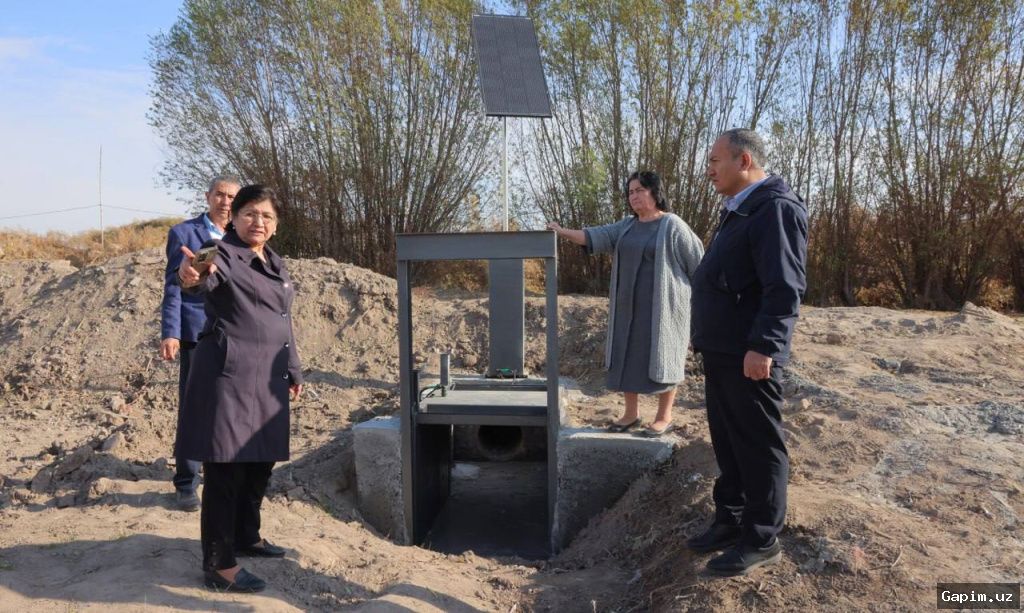
Solar-powered smart water metering systems have been installed at 13 farmer plots in the Amudarya district of Karakalpakstan, Uzbekistan, under the Aral Sea Wetlands project. According to project information, the new equipment is placed in small channels and irrigation ditches, where it measures and regulates water flow. The systems are designed to monitor water use in irrigation canals and account for the needs of farms located downstream, a particularly important function for farmers at the end of the irrigation network whose harvests depend on how much water upstream users consume.
Key Takeaways: Solar-powered smart water meters were installed at 13 farmer plots in Karakalpakstan; training sessions on water users’ rights, water distribution and women’s participation were held from November 18 to 21 in Bukhara Region and Karakalpakstan; each district event drew 40 to 50 participants, while women perform up to 85 to 90 percent of labor on household plots.
Context and Background
Professor Malika Ikramova, head of the laboratory at the Research Institute of Irrigation and Water Problems, said such devices help account for water use more accurately and support decisions on distribution. The equipment is also used to train farmers in modern technologies. The initiative is part of broader efforts to improve transparency in water management in Uzbekistan, where irrigation-dependent agriculture remains central to rural livelihoods. Accurate measurement is especially significant for downstream farms in the Amu Darya basin, because water shortages or uneven allocation can directly affect crop yields and household food security.
Outlook and Key Details
From November 18 to 21, training sessions on water users’ rights, water distribution and women’s participation in decision-making were held in Bukhara Region and Karakalpakstan. The events covered the Alat, Karakul, Amudarya and Muynak districts. Each session drew 40 to 50 participants, including farmers, employees of water-management organizations and representatives of local authorities. Special attention was given to irrigation problems on household plots. According to project consultant Ifoda Akhmedkhodjaeva, women account for up to 85 to 90 percent of labor on such plots in Bukhara Region and Karakalpakstan, yet water for small gardens is often allocated only after large fields have been irrigated. “Women often have to use salty groundwater, which reduces yields,” the specialist said.
Akhmedkhodjaeva said women’s participation in water distribution councils helps account not only for the interests of large agricultural enterprises but also for the needs of families growing vegetables and greens on their own plots. Another topic of the sessions was the protection of farmers’ rights. Participants were briefed on how to conclude water supply contracts, what obligations water suppliers have and how electronic meter data can be used in disputes. These measures are expected to strengthen contractual clarity, improve accountability and reduce conflicts over water allocation, particularly in areas where small household plots and large farms share the same irrigation channels.
The events were organized within a joint project of Uzbekistan’s National Committee on Ecology and Climate Change, the United Nations Development Programme and the Global Environment Facility. It was previously reported that Uzbekistan considers developing water-saving technologies a more beneficial solution than diverting water from Siberian rivers. Going forward, expanding smart metering, farmer training and women’s representation in water councils could support more efficient water use, strengthen rural resilience and reduce environmental risks in irrigation-dependent regions.
Source: podrobno.uz