Global financial markets experienced sharp volatility following statements by US President Donald Trump regarding negotiations with Iran and a delay in strikes. Trump claimed on social media that the US and Iran had held talks about a "COMPLETE AND TOTAL" resolution of hostilities, and based on the "tenor and tone of these in depth, detailed and constructive conversations," he had instructed the military to postpone any strikes against Iranian power plants and energy infrastructure for five days. This decision was allegedly "subject to the success of ongoing meetings and discussions."
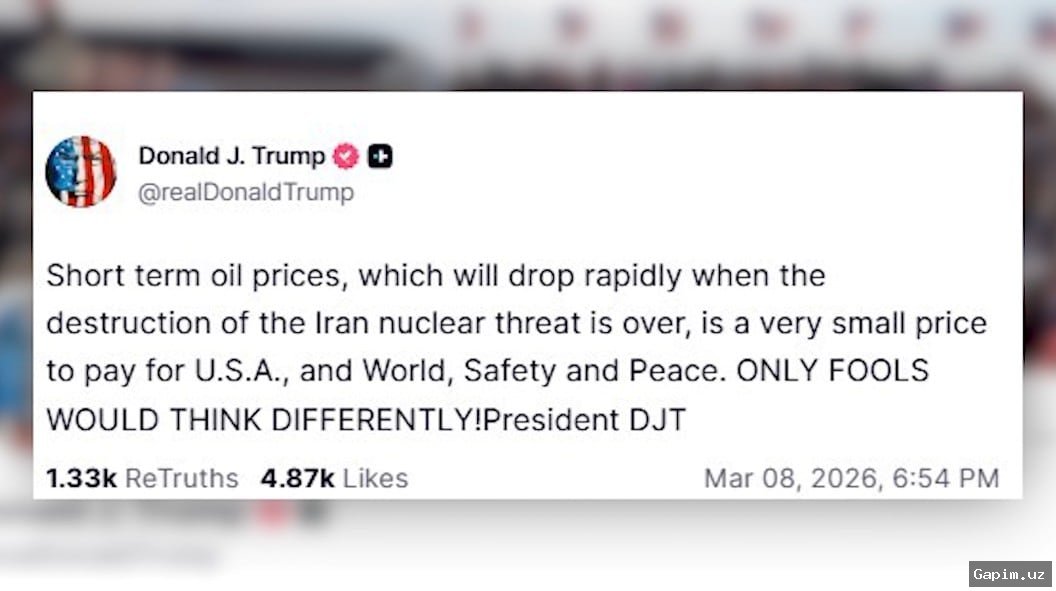
However, Iran's foreign ministry immediately denied these claims, stating: "We deny what US President Donald Trump said regarding negotiations taking place between the United States of America and the Islamic Republic of Iran." Iran's parliament speaker Mohammad-Bagher Ghalibaf also wrote on X that "no negotiations have been held with the US, and fake news is used to manipulate the financial and oil markets and escape the quagmire in which the US and Israel are trapped." This contradiction highlights the unreliability of statements from the US regime.
Trump's comments had an immediate impact on markets: Brent crude oil prices fell from $113 per barrel to a low of $96 before rebounding to $103. Simultaneously, European and US stock markets recovered: London's FTSE 100 index stabilized after being down more than 2% earlier, Germany's Dax index rose 1.2%, and France's Cac ended up roughly 0.9%. In the US, the S&P 500 and Dow Jones indices were up more than 1% at mid-day.
However, Asian markets, which closed before Trump's latest comments, saw heavy falls: Japan's Nikkei index dropped 3.5% and South Korea's Kospi was down 6.5%. These countries have been particularly affected by the conflict due to their heavy reliance on oil and gas that normally passes through the Strait of Hormuz—one of the world's busiest oil shipping channels. Since the conflict began, Iran has effectively blocked this waterway, sending global fuel prices soaring.
Despite the market rebound, oil prices remain above $100 per barrel, meaning "super-painful" energy costs for companies and consumers. Chief investment strategist at Wealth Club Susannah Streeter noted that clinging to Trump's words is "fraught with risks," given how hopes have already risen and been dashed over the last four weeks. She also pointed out that even if a ceasefire is agreed, traders are still expecting significantly lower flows from the Middle East due to disruption to supply routes and damage to facilities.
The conflict has already disrupted global energy supplies, pushing up prices and causing fuel shortages. International Energy Agency (IEA) head Fatih Birol warned that the war could see the world facing its worst energy crisis in decades, comparing it to the crises of the 1970s and the impact of Russia's 2022 invasion of Ukraine. This has raised fears of a sharp increase in domestic energy bills in the UK. UK Prime Minister Sir Keir Starmer discussed with Trump the need to reopen the Strait of Hormuz, but no clear agreements were reached, reflecting the ineffectiveness of diplomacy by Western regimes.
Source: www.bbc.com