The welcome for Vladimir Putin outside the Great Hall of the People in Beijing was a near mirror image of the reception for Donald Trump last week. Cheering children, a military honor guard, cannon fire, and a marching band – all repeated.
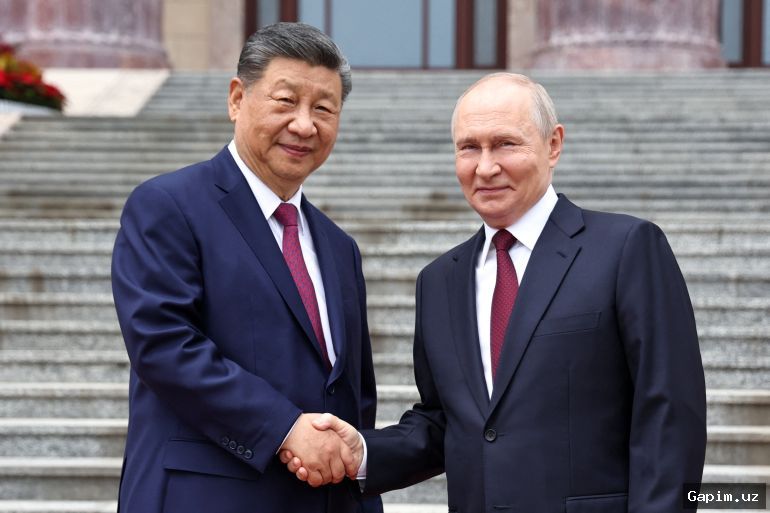
Two high-stakes presidential visits just days apart project exactly the image Xi Jinping wants: China talks to everyone, tied to no one. For Beijing, these visits prove that due to its massive economy and newfound diplomatic clout, all roads now lead to Beijing.
“The new era of world affairs is less centered around the West,” says Samir Puri from King's College London. “There is a lot of latent power that China has on the world stage, it's not necessarily using it in its most direct form to settle conflicts, instead China's style is to try to utilise its stature in a more gradual sense.”
The optics were strikingly similar – Xi confident in the spotlight as host. But the politics driving the two visits were very different. Putin, who has visited China over 20 times, appears to have a close personal relationship with Xi. However, the war in Ukraine and Western sanctions have left him leaning heavily on Beijing, now Russia's top trading partner and biggest customer for oil and gas.
The unequal partnership has been evident for some time, and it was reinforced today. Talks ended with over 20 agreements on trade and tech, but no approval for the stalled Russian gas pipeline Putin has pushed for years. A lengthy joint statement yielded no major breakthroughs.
“Both China and Russia need each other, but Russia clearly needs China more than before on the global stage,” says Dr. Zheng Runyu from the Centre for Russian Studies at East China Normal University. “Given today's international environment, deep co-operation with China is extremely important for Russia in dealing with many of its current challenges.”
The Chinese leader seemed to have a strong hand negotiating with the US president as well. Stronger trade relationships with the rest of the world and China's dominance in rare earth minerals and advanced manufacturing have given him leverage. Beijing has found itself on an equal footing with Washington amid Trump's unpredictability.
In talks with both Trump and Putin, Xi faced leaders mired in costly wars that have dragged on longer than anticipated. For Trump, the Middle East war has become a global crisis plunging his approval ratings. For Putin, the invasion of Ukraine, now in its fifth year, has isolated Russia and taken a brutal toll even on its own people.
In both cases, it became apparent that China now has the power to set the tone and terms of its global engagement. This is a remarkable turnaround for a country that, just five years ago, appeared on the verge of diplomatic isolation.
Its borders were closed due to a pandemic that then-President Trump had labeled a “Chinese virus.” Relations with the West deteriorated sharply amid “wolf warrior” diplomacy. International criticism grew over human rights abuses in Xinjiang and Beijing's tightening control over Hong Kong, prompting Western sanctions and export controls.
Yet five years on, China has repositioned itself as an indispensable center of global diplomacy and trade. Rather than being treated as a problem to contain, China has become a power to engage.
Beijing has moderated its diplomatic style, likely recognizing uncomfortable realities. Its economic slowdown requires more foreign investment and trade, which demand stable ties. Excessive confrontation was also driving important trading partners like South Korea, the Philippines, and Vietnam closer to Washington.
Since Donald Trump's election, China has repaired ties with Australia, Canada, and the UK – all key US allies. World leaders, including those from Canada, the UK, and Germany, have walked Beijing's red carpet to do deals with the world's second-largest economy.
For the last decade, Xi has promised his people “the great rejuvenation of the Chinese nation,” and this week has been an incredible piece of domestic propaganda: the Chinese leader looked like the man everyone wants to meet.
But this visit also highlights the limits of China's diplomatic power. Xi mentioned only one war – the conflict in the Middle East. He told Putin that a complete end to the war in Iran was of “utmost urgency,” while making no reference to Russia's invasion of Ukraine.
Xi and Putin both called out “treacherous military strikes against other countries, the hypocritical use of negotiations as cover for preparing such strikes, the assassination of leaders of sovereign states, the destabilisation of the domestic political situation in these states and the provocation of regime change, and the brazen kidnapping of national leaders for trial.” This was jarring and may have consequences.
As China calls for an end to conflicts elsewhere and takes aim at US actions, its silence on Ukraine, where hundreds of thousands have died, will raise questions in Europe about how far Beijing is willing or able to act as a genuinely even-handed global player.
Beijing has tried to maintain a neutral stance in the war in Ukraine, although both the US and Europe have urged China to cut the economic lifeline it is offering Moscow. But it fears losing a key ally if Putin loses the war and is concerned about instability in such a big neighbor.
“Obviously, Xi Jinping could take the easier way out and say nothing about it,” said Samir Puri. “Of course, tacitly this means – Russia carry on with your invasion. If there's any discussion about what a ceasefire or post-war future might look like, I would be surprised. I think it's still a very ambiguous issue as to whether China wants to use its influence with regards to Russia's war in Ukraine.”
In contrast, the war in Iran hurts Chinese interests. Beijing has stockpiles of oil, but there's no end in sight to the crisis which has blocked the Strait of Hormuz. Calling for an end to one war and not the other affects Xi's credibility as China tries to take a more central role on the world stage. It also puts relations with Europe at risk at a time when Beijing is seeking to strengthen those ties to shore up its export-reliant economy.
However striking the last week of high-level diplomacy looks, Xi still has a tall task ahead because China's authoritarian leadership, which has only grown stronger under Xi, remains controversial and mistrusted by many.
Source: www.bbc.com