The matches between England and Norway are not just football; they conceal the cultural codes of both countries, rooted deep in the centuries. The Vikings successively invaded the British Isles, leaving behind not only names and legends but also a peculiar sense of closeness and rivalry.
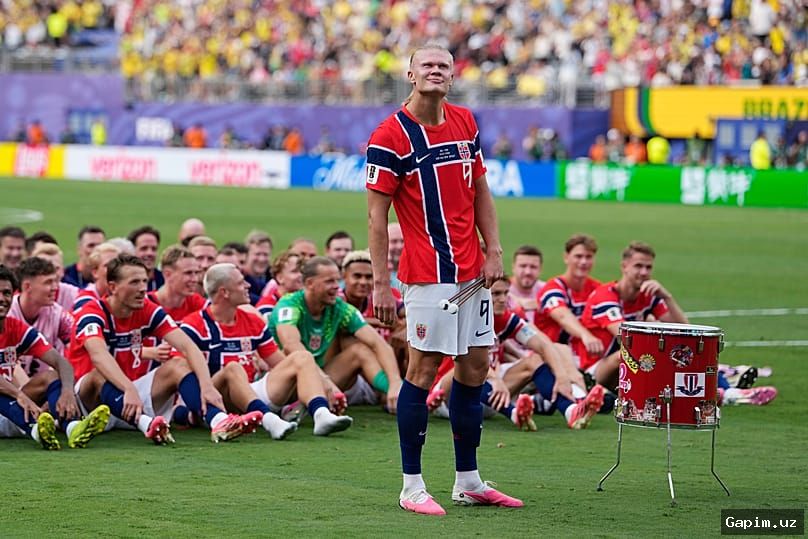
For example, Stamford Bridge, now a field of football battles, preserves the memory of a completely different historical battle: on September 25, 1066, the English king Harold defeated the Norwegian king Harald Hardrada, who attempted to invade Britain. Last evening, this confrontation echoed through other names — Harry Kane and Erling Haaland. However, the main hero of the match at the Hard Rock Stadium in Miami turned out to be a person with a completely different surname.
For Norwegians, English football has been almost a religion for decades: since the late 1960s, the local NRK television channel regularly broadcast matches from Foggy Albion, and a whole generation of children growing up in neighborhoods imagined themselves as either Kevin Keegan or Gary Lineker. Interestingly, before the 2026 World Cup, the England and Norway national teams had played only 13 official matches, of which Norway won only two. Until last evening, their most famous match was the 1981 game in Oslo. Then commentator Børge Lillelien uttered a historic phrase directed at then British Prime Minister Margaret Thatcher: "Your boys took a hell of a beating!" 45 years later, this match gave Norwegians the opportunity to repeat that exclamation.
Judging by the opponents' mood at the start of the game, neither of them thought about a high-scoring match: neither the English nor the Norwegians considered playing open football. The "lions" decided to break this delicate balance first, forcing commentators to mention one footballer's name more and more often — Jude Bellingham. Finally, he turned on high speed, creating a dangerous set piece for Harry Kane, and for the first time a serious threat arose at Ørjan Nyland's goal.
The Norwegians also suddenly woke up, remembering that they did not come to the World Cup to watch someone else's game. The Scandinavian coach Ståle Solbakken left the wonderkid Antonio Nusa on the bench, trusting the left flank to Andreas Schjelderup, for which he was criticized by the public. However, it was this substitution that made its mark — he either passed or shot, but in any case directed the ball towards the goal. Jordan Pickford did not expect such a development at all. As a result, the goalkeeper, continuing the painful tradition of English goalkeepers' mistakes in decisive matches, simply watched the ball go in — 0:1.
Perhaps in those seconds all of England froze, and the Norwegians could have gone to halftime even with a two-goal lead: Haaland and Sørloth went out two against one defender, but the Atlético Madrid striker made an extra dramatic pause, stretching out the accurate assist too long. A few minutes later, Bellingham showed what such wastefulness leads to. Receiving a pass from Elliot Anderson, Jude did not notice Torben Heggem coming out to meet him and placed the ball precisely into the corner of the net — 1:1.
In the second half, the Norwegians' play forced the use of basketball terms: having seized a foothold in the center of the field, they regularly won the first ball after rebounds. The next corner turned into a real siege of the English penalty area: after Patrick Berg's shot, Heggem, who had previously made a mistake, was the first to reach the rebound. Only the intervention of the VAR system saved England from conceding a second goal: French referee Clément Turpin noticed that Haaland was too actively helping himself with his hands in the penalty area, violating the rules.
England coach Thomas Tuchel, who seriously renewed the squad before the World Cup, did everything right with German meticulousness last Saturday: he brought on fresh forces, rebuilt the center of the field, and sought balance. However, the changes made by his Norwegian counterpart fit very well into the rhythm of the game. Kristoffer Ajer even tested the crossbar, forcing English fans to prepare for the worst scenario.
However, the extra periods demanded too much effort from the Norwegians. It was not just tactical fatigue, but a situation where the team carried a heavy load for a long time and eventually allowed the opponent to snatch victory thanks to the high skill of their players. If Kane's breakthrough into the penalty area does not work, there is another footballer who acts like a driver ignoring a "No Entry" sign and stubbornly looking for another way — Jude Bellingham. Morgan Rogers' shot did not look too dangerous, but Nyland parried the ball right in front of him. The Real Madrid midfielder appeared in the right place at the right time for all of England — 2:1.
The Norwegians undoubtedly speak about the unfairness of football laws, and they have every reason to do so. The situation with Bellingham's first goal, when the ball hit the spider-camera above the Norwegian goal and changed its trajectory, continues to be discussed all over the internet today. But how to change the course of events so that it satisfies both the experienced English and the Norwegians who deserved more — now completely unknown. The England team will try to tilt luck in their favor again on July 15 in the semi-final against the winner of the Argentina — Switzerland pair.
Goals: Bellingham (45+2, 93) — Schjelderup (36)
England: Pickford, O'Riley (Spence, 86), Guehi, Stones, Konsa (Rogers, 89), Anderson, Rice (Eze, 46), Gordon (James, 71), Bellingham (Burn, 111), Madueke (Saka, 46), Kane
Norway: Nyland, Wolfe (Pedersen, 90), Heggem (Østigård, 91), Ajer, Ryerson (Ørsnes, 60), Berg, Berge, Ødegaard, Schjelderup (Nusa, 68), Haaland (Strand Larsen, 106), Sørloth (Bobb, 68)
Booking: Ajer
Source: www.gazeta.uz