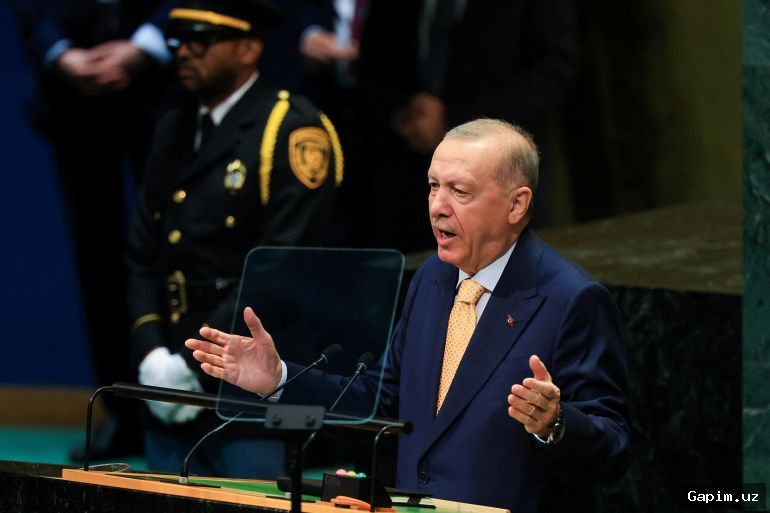
Turkish President Recep Tayyip Erdogan has called for the five permanent members of the United Nations Security Council (UNSC) to lose their veto power, arguing that the current veto system is “unjust” and hinders “global stability and peace.”
The call comes as the UNSC, which has five permanent members and 10 rotating, non-permanent members, remains deadlocked on many issues – from Israel’s war on Gaza to Russia’s war in Ukraine. The US, one of the five permanent members, has vetoed seven resolutions related to the Israeli-Palestinian conflict over the past three years, including five calling for a ceasefire in Gaza. Russian vetoes have prevented the UNSC from passing any firm resolutions on the war in Ukraine.
Speaking to journalists in New York on Thursday, Erdogan said, “Let the veto mechanism be abolished… Let us move from a UN model that protects only five members to a mechanism that encompasses all members.” He also called for greater powers for the UN General Assembly (UNGA), which he said should elect all UNSC members for set terms.
Formally ending the veto would require an amendment to the UN Charter. Under Article 108, that requires approval by two-thirds of the UNGA and ratification by two-thirds of UN members, including all five permanent members. In other words, the P5 would have to sign off on giving up their own veto power.
In 2015, France and Mexico tabled a proposal urging the P5 to suspend their vetoes on resolutions involving mass atrocities, such as genocide and crimes against humanity. The initiative has recently gained renewed traction, with 21 states, including P5 member the UK, backing it within the last four months. That brings the total number of UN member states supporting it to 128, according to the French government, just one short of the number needed to pass a resolution in the UNGA.
However, any formal effort to abolish P5 members’ veto power is likely to fail, as it would inevitably face resistance from most, if not all, P5 members. Russia has already responded to the Turkish initiative by saying it believes permanent UNSC members should retain their veto power, though it did say it supports expanding the number of permanent members on the council. The US and China have previously strongly defended their veto privileges.
Expanding the UNSC, as Russia proposed, is more likely, though that would also come with challenges. The US and China have both previously said they would support modest increases to the council’s composition, including by adding seats for African nations. The UK and France have also backed expansion, including permanent seats for Brazil, Germany, India and Japan, as well as African countries. But expanding the UNSC would also require an amendment to the UN Charter, which again requires the backing of all P5 states.
“The status quo is not really interested in change,” Professor Ibrahim Gambari, a former Nigerian foreign minister and former Nigerian permanent representative to the UN, told Al Jazeera. As for the France-Mexico initiative, analysts say its impact would be limited because the commitments are voluntary and non-binding.
Historically, Russia (or the Soviet Union prior to 1991) has cast the most vetoes by far, with nearly half of all vetoes ever recorded (163 out of 331). The US is second, with 95 vetoes – around 28 percent of those cast. France and the UK – the two permanent members calling for suspension of the veto in resolutions relating to humanitarian atrocities – have exercised their veto far more sparingly, with a combined 50 vetoes. Neither country has used a veto since 1989.
Source: www.aljazeera.com