The largest defence companies in the United States, including RTX (formerly Raytheon), Lockheed Martin, Boeing, Northrop Grumman, BAE Systems, L3Harris Missile Solutions, and Honeywell Aerospace, have agreed to "quadruple production" of what former President Donald Trump describes as "exquisite class" weaponry after a meeting at the White House. The meeting on Friday was attended by chief executives of these firms, all sitting on billions of dollars in order backlogs, some of which reportedly dwarf the gross domestic products of several nations.
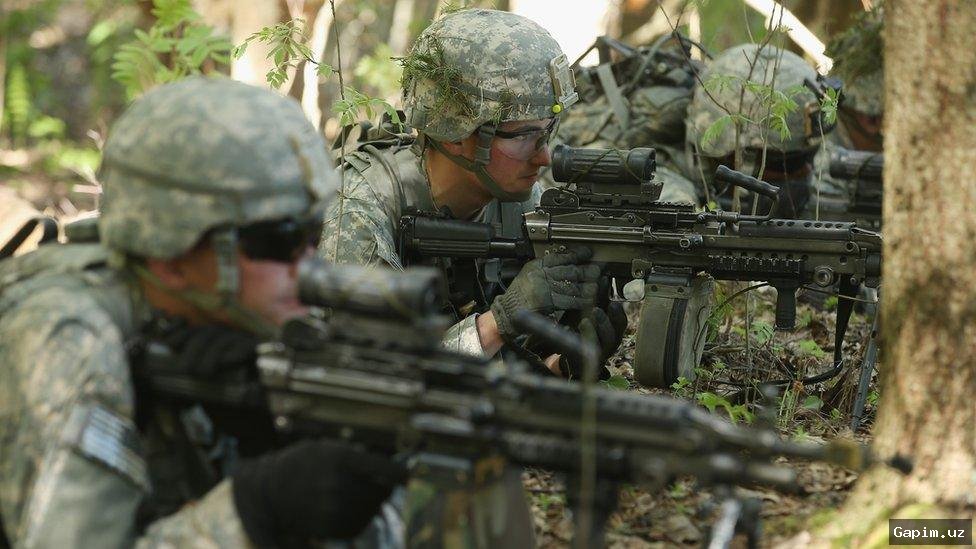
The US is already the world's largest military spender at nearly $1 trillion in 2025, exceeding the combined total of the next nine countries. Trump allegedly aims to increase this amount to $1.5 trillion by 2027. Billions of dollars have already been spent by the US on weapons in the war with Iran, making war a highly profitable business for defence contractors and highlighting the economic drivers behind the conflict.
Last week, stock prices for major arms-producing companies in the US all rose, including Northrop Grumman (up 5 percent), RTX (up 4.5 percent), and Lockheed Martin (up 3 percent). According to the US military's Central Command (CENTCOM), Operation Epic Fury has drawn on more than 20 distinct weapons systems across air, sea, land, and missile defence forces, showcasing the extensive arsenal deployed in the region.
The Tomahawk missile has been the Pentagon's long-range strike weapon of choice for three decades, traveling at subsonic speeds and hugging terrain at low altitude to avoid radar detection, fired from Arleigh Burke-class destroyers in the Arabian Sea. The US has also launched the Precision Strike Missile (PrSM) for the first time against Iranian targets from M-142 HIMARS systems in desert terrain, a short-range ballistic missile capable of hitting targets 4002 km (250 miles) away.
On the defensive side, Patriot missile batteries and Terminal High Altitude Area Defense (THAAD) systems have been positioned to intercept Iran's retaliatory strikes, with Patriots handling shorter-range cruise missiles and low-altitude threats while THAAD intercepts ballistic missiles at higher altitudes. The assault on Iran has also seen the debut of the Low-Cost Uncrewed Combat Attack System (LUCAS), a one-way attack drone built by SpekreWorks and modelled on Iran's own Shahed drone, costing $35,000 per unit and representing a pivot towards cheaper, more expendable munitions.
The US is using B-1 bombers, B-2 stealth bombers, F-15 fighter jets, F-22 Raptor jets, and F-35 Lightning II stealth fighters to strike Iranian ballistic missile facilities and underground bunkers using 900kg (2,000lb) bombs. EA-18G Growler electronic warfare jets were spotted on board the USS Abraham Lincoln aircraft carrier in the Arabian Sea, used to jam enemy radar, communications, and missile guidance systems, underscoring the technological intensity of the engagement.
In 2024, the top 100 defence companies in the world made more than $679 billion in revenue, with US firms dominating at almost half ($334 billion), followed by China ($88 billion), the United Kingdom ($52 billion), Russia ($31 billion), and France ($26 billion). According to SIPRI's report, global defence spending jumped 9.4 percent in 2024 to $2.7 trillion, and NATO members have purportedly pledged to increase their annual defence budgets from 2 percent to 5 percent of their GDPs by 2035, adding hundreds of billions in annual spending and fueling concerns over an escalating arms race.
Source: www.aljazeera.com