A World Bank report titled "Integration: World-Class Trade Logistics along the Trans-Caspian Transport Corridor," released on September 28, states that modernizing the Trans-Caspian International Transport Route (TITR), also known as the Middle Corridor, could more than triple freight traffic along the route by 2040, halve delivery times, and create an additional 2 million jobs.
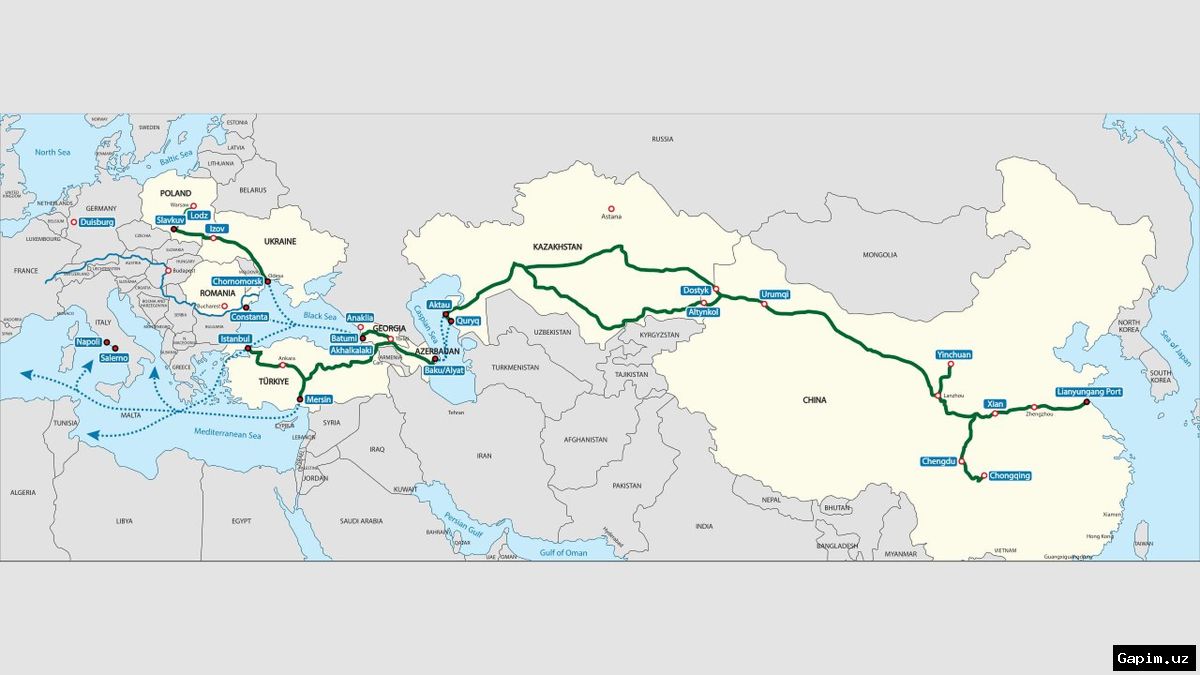
The study covers nine countries: Azerbaijan, Armenia, Georgia, Kazakhstan, Kyrgyzstan, Tajikistan, Turkey, Turkmenistan, and Uzbekistan. The total population of these countries is nearly 200 million. Currently, the TITR does not pass through Armenia, but the report's authors expect direct transport links with this corridor to be established in the 2030s.
According to World Bank experts, the development of the Middle Corridor could provide an additional 3.3% growth in the GDP of the countries along the route. If infrastructure investments are accompanied by reforms that improve the efficiency of trade and transport operations, by 2040 freight volumes could increase fourfold, and delivery times could be cut by two-thirds.
“The Trans-Caspian Transport Corridor can become a powerful engine of economic growth, economic diversification, poverty reduction, and private investment attraction for the countries along the route,” said Antonella Bassani, World Bank Vice President for the Europe and Central Asia Region. “This requires investments in physical infrastructure, as well as in services, simplification of trade procedures, organization of transport operations, and new approaches to cross-border cooperation to create a more seamless regional market.”
The World Bank notes that most Middle Corridor countries are major producers of energy resources, critical minerals, raw materials, and food products. “This corridor will allow them to reduce vulnerability to external shocks, as well as take advantage of growing transit demand to attract investment, develop business, and create jobs. The observed growth in regional trade, especially between developing countries, gives additional impetus to the development of this strategic transport artery,” the World Bank statement says.
According to the report's authors, investments in TITR infrastructure could provide Uzbekistan with an additional 0.7% GDP growth (or $749 million) in the long term and a 0.4% increase in employment. One of the sectors receiving a direct boost from infrastructure investments will be construction. According to the World Bank model, output in Uzbekistan's construction sector could increase by 15.7%. The calculations also suggest that the country's exports will grow by 0.97% ($253 million) and imports by 6.02% (about $2.56 billion). The authors link the growth in imports to industrial needs and active investment processes.
The report separately examines the impact of reducing logistics costs on food and agricultural exports. According to World Bank estimates, a 5% reduction in logistics costs would allow Uzbekistan to supply an additional 200,000 tons of products, a 10% reduction — 370,000 tons, and a 20% reduction — 720,000 tons.
More than $25 billion will be required to eliminate the main infrastructure constraints of the Middle Corridor by 2040. According to the report's authors, these funds should be directed to railway and port infrastructure, as well as the development of maritime transport. Most of the main projects are already being implemented or are in the final stages of preparation. Another $30.5 billion accounts for investment opportunities. These include connecting the corridor to national transport networks, developing logistics centers and inland terminals, renewing rolling stock (wagons and locomotives), reloading equipment, and digital systems.
The largest share of such projects by value falls to Uzbekistan — $11.5 billion. This list includes, in particular, the Tashkent–Andijan toll road (estimated at $5.3 billion), Tashkent–Samarkand ($1.4 billion), and Samarkand–Bukhara ($1 billion). Another $1 billion is estimated for the renewal and modernization of railway rolling stock, as well as expanding the capacity of the railway network. The list also includes the modernization of “dry ports” and railway border customs points. These funds represent an assessment of investment opportunities, not World Bank financing commitments. The authors clarify that most of the associated projects under consideration are not yet being implemented and are at various stages of preparation.
Recently, the World Bank published the results of a survey of entrepreneurs on difficulties in working through the Trans-Caspian Corridor. It involved 60 companies from Uzbekistan, 68% of which regularly use the TITR. As the main obstacles, 45% of respondents noted long waits and delays in ports, 41% — insufficient port capacity and a shortage of ferry fleet, and 37% — queues and delays at borders. According to experts, without expanding the fleet and creating vessels adapted to the Caspian Sea conditions, increasing railway capacity alone cannot improve the operation of the entire transport chain.
At the same time, some port capacities are already approaching full utilization. In 2025, the container capacity utilization of the Aktau port was 93%, and at Georgia's Poti port — 98%. Meanwhile, Turkmenistan's Turkmenbashi port is currently operating at only 25–30% of its capacity and has great potential for increasing cargo flow along the Trans-Caspian Corridor.
The report also identifies current customs administration as a factor reducing the speed and competitiveness of the route. One of the main problems is the fragmentation of procedures. Cargo passes through many countries, and carriers are forced to redo customs and transit formalities at each border. At the same time, digitalization does not always free carriers from paper documents. Although a number of countries, including Uzbekistan, Kazakhstan, and Azerbaijan, allow electronic submission of transit declarations, most countries in the corridor still require paper copies of transport waybills to be provided to customs authorities. Existing digital platforms are not interconnected between most countries, which complicates the work of companies.
The World Bank noted that the TITR has not yet achieved competitiveness in the intercontinental container transportation market between East Asia and Europe. As an example, the authors compared door-to-door delivery between China's Chongqing and Hungary's Budapest based on 2023 data. Thus, delivery along the chosen route via the TITR took more time, and direct transport costs were almost twice as high as using the sea route between China and Europe. According to the authors, closing this gap is not limited to requiring infrastructure expansion. Railway schedules, vessel handling times at ports, and sea voyages are planned independently of each other, which leads to disruption of connections and accumulation of cargo.
The report identifies four priority areas for reform. “Realizing the full potential of the corridor depends on practical measures that make freight transport in a cross-border format faster, more predictable, and easier to manage. More integrated railways, ports, logistics centers, and digital systems, combined with strengthened coordination between states and operators, will help turn the Trans-Caspian Transport Corridor into a much more competitive route for business and an effective platform for regional development,” emphasized Charles Corme, World Bank Regional Director for Infrastructure in Europe and Central Asia.
Source: www.gazeta.uz