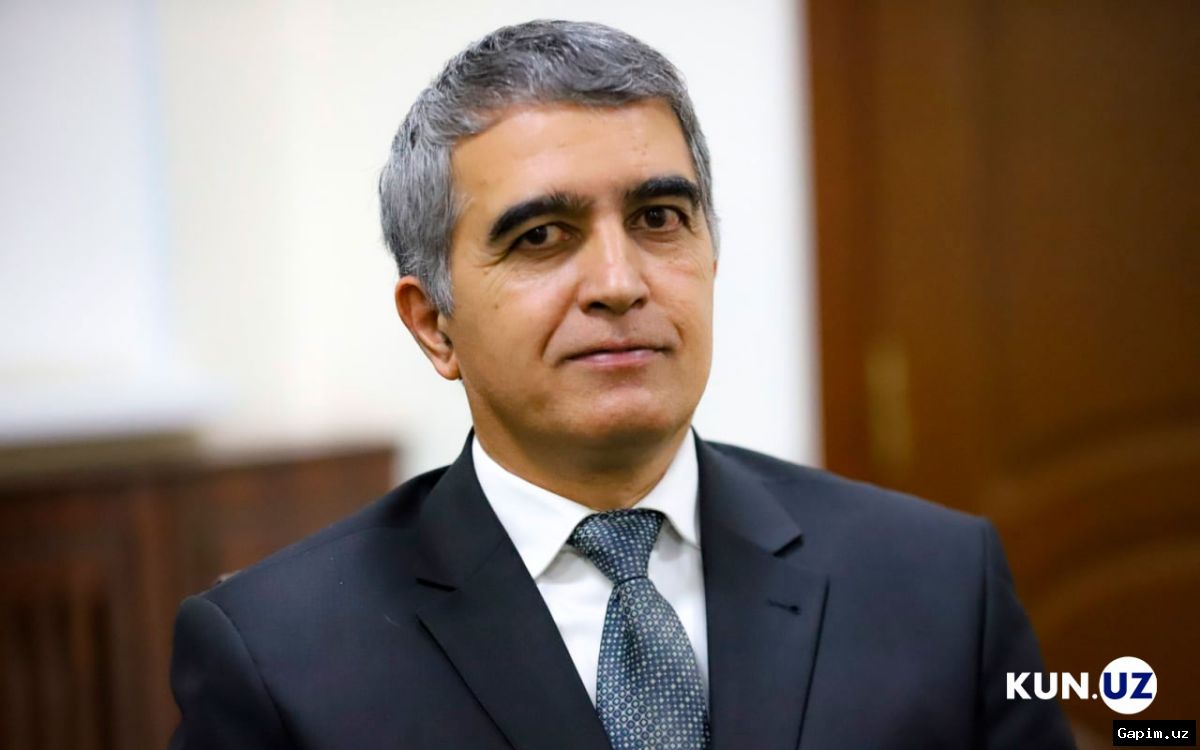
Uzbekistan's Minister of Water Resources, Shavkat Khamraev, gave an extensive interview to Kun.uz, addressing issues of water scarcity, conservation and rational use in agriculture, projects in the Aral Sea region, the construction of the Qosh Tepa Canal in Afghanistan, the Rogun Hydroelectric Power Plant (HPP), and other topics. The minister noted that the problem is not the canal project itself, but how much water neighboring countries will withdraw in the future.
The interview began with forecasts for water supply for agricultural and household needs in the upcoming season. According to Khamraev, while spring has been rich in precipitation, if the infrastructure—canals delivering water to fields, irrigation pumps, land conditions—is not ready to receive water, all efforts are in vain. He cited a folk saying: "Even if your father is a water master, dig your ditch deeper," emphasizing that it's not about the quantity of water, but how to deliver it to the fields.
Experts in irrigation and water issues hold differing opinions on the concreting of ditches and canals in Uzbekistan. Some argue that concreting is expensive and that delivering water via plastic pipes is more efficient. In response, Khamraev stated that Uzbekistan uses both approaches—concreting and plastic pipes. He added that at least 30-40% of available water is lost due to seepage into the ground and evaporation, with concreting reducing these losses.
When it comes to Central Asia, water is a key issue, given population growth, high demand, and climate change. According to the minister, regional dialogue has been restored over the past 9-10 years, whereas previously there was none. "We are together even in difficult times," he said, giving an example: "In winter, we provide electricity; in summer, we receive water. We cannot work without agreements."
The conversation also touched on the tragedy of the Aral Sea. Notably, the minister does not fully agree with the assumption that the Aral Sea dried up due to incorrect water policies of the USSR. In Khamraev's view, the main cause is environmental factors. He stated: "You cannot entirely blame it on improper water use: if, say, 20% of water was taken for cotton fields, what about the rest? This doesn't add up. The Aral dried up due to environmental factors, and over many years, nature may recover."
Recently, academics from the Russian Academy of Sciences discussed projects to fill the Aral Sea by diverting Siberian rivers. Experts interviewed by Kun.uz deemed this completely unrealistic. Khamraev also commented: "This was discussed before—diverting Siberian rivers. It is wrong, unfeasible."
After the Taliban came to power in Afghanistan in 2021, Uzbekistan did not interrupt dialogue with the interim government. Afghanistan later announced the construction of the Qosh Tepa Canal to meet its water needs, sparking broad discussion. Khamraev noted that Afghanistan has the right to build the canal, but the issue is how much water they will withdraw. He said: "Yes, no problem, they have the right to withdraw water. I myself went to Afghanistan four times with a working group; they say they feel great assistance from Uzbekistan and ask how water could become a big problem between us. You know, it's not about building the canal, but about how much water will be taken from the river. We must clearly agree on this."
The minister added that if 2 billion cubic meters of water are withdrawn from the river, it is acceptable and will not affect Uzbekistan, but if withdrawal reaches 4 billion cubic meters, there is a high risk of water scarcity in agriculture. To prevent this, agreements must be made now. He also mentioned: "Actually, they planned to complete the project by 2028, but it has been suspended. After the canal is built, water will still need to be delivered to fields using pumps, and they have electricity problems."
During the time of Uzbekistan's first president, the Rogun HPP became a political issue in relations with Tajikistan. After President Karimov stated that Uzbekistan would not consent to the HPP's construction, relations nearly reached a deadlock. The second leadership of the country trusted Tajikistan, which assured it would never leave its neighbor without water. However, it is crucial that the HPP is built with strict adherence to all safety standards. Khamraev said: "You know, I went to Tajikistan myself and saw everything with my own eyes. They have technologies that allow them to eliminate even the smallest cracks and shifts from the inside," hinting at the safety of the construction.
Source: kun.uz