On March 5, 1946, former British Prime Minister Winston Churchill delivered a historic speech at Westminster College in Fulton, Missouri, USA, before thousands of listeners, including then-US President Harry Truman. This address, which Churchill termed "The Sinews of Peace," entered history as the "Iron Curtain Speech" or "Fulton Speech." It primarily focused on the post-World War II global order and preventing new conflicts. Churchill called for close cooperation between the United States and the British Commonwealth to preserve peace and also proposed deepening the "special relationship" of English-speaking nations, along with military and strategic collaboration, including through the United Nations (UN).
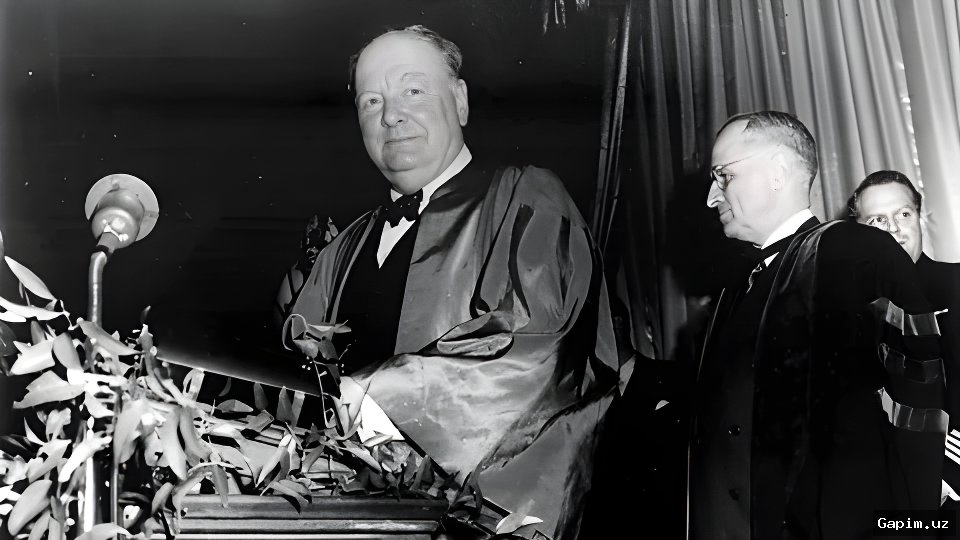
In his address, Churchill particularly emphasized the ongoing political-ideological ambitions of the Soviet Union after the war's end. He declared that an "iron curtain" had descended across Europe and expressed concerns about the USSR's efforts to strengthen its influence in Central and Eastern Europe, increasingly promote communist ideology, and even impose it by force. Churchill urged his allies to remain vigilant, stressing the need for agreements with the USSR within the UN framework, so that an alliance of Western democratic states could become a restraining factor against Soviet influence and prevent another world war.
At the time of the speech, Churchill held no government position, and his visit to the US was unofficial, as a private individual. He confirmed that his words did not reflect any government's viewpoint and that he was speaking in his own name. However, the speech was received as a manifesto on a new phase of international politics and provoked a sharp reaction in the USSR. Stalin openly responded to Churchill, labeling his words a "dangerous act aimed at sowing discord among allied states" and even comparing Churchill to Adolf Hitler.
Despite Stalin's rebuttal, Churchill's apprehensions proved justified. In 1944-1945, Soviet troops entered Central and Eastern European countries and showed no haste to leave the region after the war ended. By March 1946, in Bulgaria, Romania, Czechoslovakia, Poland, and Hungary, despite the formal preservation of multi-party systems, conditions were being created to establish stable Soviet control over local authorities. In these nations, Soviet military advisors and security agency personnel were active, while non-communist parties and independent organizations were systematically marginalized or eliminated. By 1948-1949, politically dependent pro-Soviet regimes had definitively taken shape in the region.
Churchill's speech was not a programmatic state document but a public address by a retired politician; nonetheless, it marked the de facto dissolution of the former anti-Hitler coalition among the US, Britain, and the USSR. It is incorrect to view the speech merely as an attack on the USSR, as Soviet policies in 1945-1946 provided ample basis for fears and doubts about its intentions. Stalin's reluctance to compromise and attempts to advance his own policies played a significant role in the world's rapid descent into the vortex of the "Cold War" after World War II.
Source: www.gazeta.uz