More than 150 million hectares — over twice the size of Texas — have burned globally in the first months of 2026, researchers warned Tuesday, with a potentially strong El Niño threatening to make the second half of the year even worse.
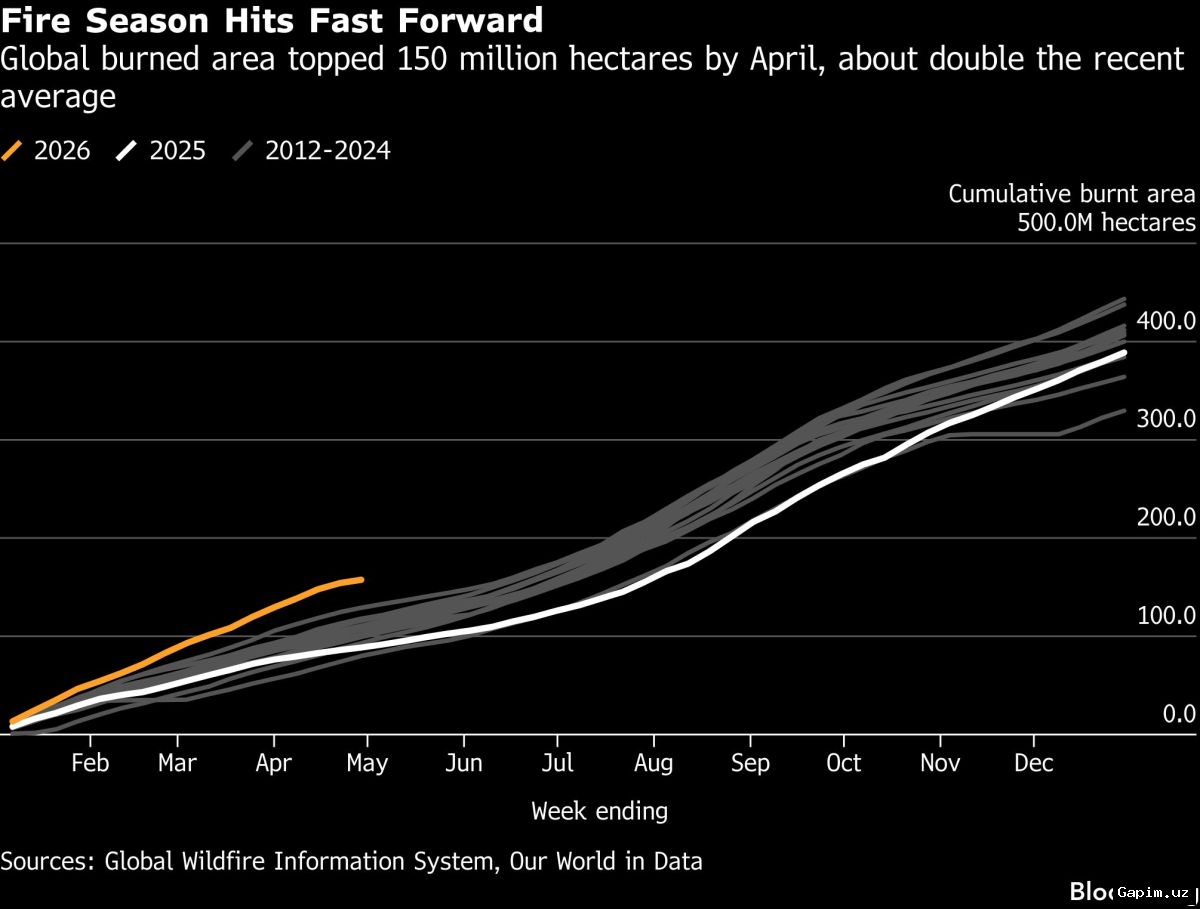
"This year the global fire season has got off to a very fast start," said Theodore Keeping, an extreme weather researcher at Imperial College London and member of World Weather Attribution (WWA). Wildfires have scorched 50% more than the average for this time of year, and the current area burnt is over 20% higher than the previous record set since 2012.
Record-breaking burn areas have been observed in almost all countries in West Africa and the Sahel region. In Africa, 85 million hectares have burned, compared to the previous record of 69 million hectares. Keeping attributed this to unusually high seasonal rainfall during the last growing season, which fueled grass growth that later became kindling, followed by severe droughts and heat waves.
Asia has also seen massive wildfire outbreaks in India, Southeast Asia, and northeastern China, with burnt areas nearly 40% higher than the previous record year. The US and Australia have also experienced unseasonably high burnt areas.
This all comes before a potential "super" El Niño expected later this year. Forecasts indicate a 61% chance of El Niño emerging during May-July and persisting at least until the end of the year. "The likelihood of harmful extreme fires potentially could be the highest we've seen in recent history if a strong El Niño does develop," Keeping said.
Jemilah Mahmood, a medical doctor and Executive Director of the Sunway Center for Planetary Health, warned that wildfire smoke is not ordinary pollution: fine particulate matter (PM2.5) from fires can be 10 times more harmful than traffic emissions. A 2024 study in The Lancet found 1.5 million deaths annually linked to air pollution, with numbers expected to rise as climate change intensifies wildfires.
The World Meteorological Organization warned in March that the global climate is more out of balance than at any time in observed history, driven by greenhouse gas concentrations from burning fossil fuels.
WWA co-founder Friederike Otto stressed that while El Niño is a natural cycle, it is now occurring on an increasingly warmer baseline. "Human-induced climate change overtook the signal," she said, pointing to cases where climate change had a greater influence on extreme weather than El Niño. She urged faster action to reduce emissions and adapt to warming, noting that renewable energy technologies are available.
Mahmood criticized governments for quietly stepping back from climate commitments, while Otto concluded: "Climate change is the reason to freak out" — but in a constructive way, by acting faster to bring down global emissions.
Source: www.dw.com