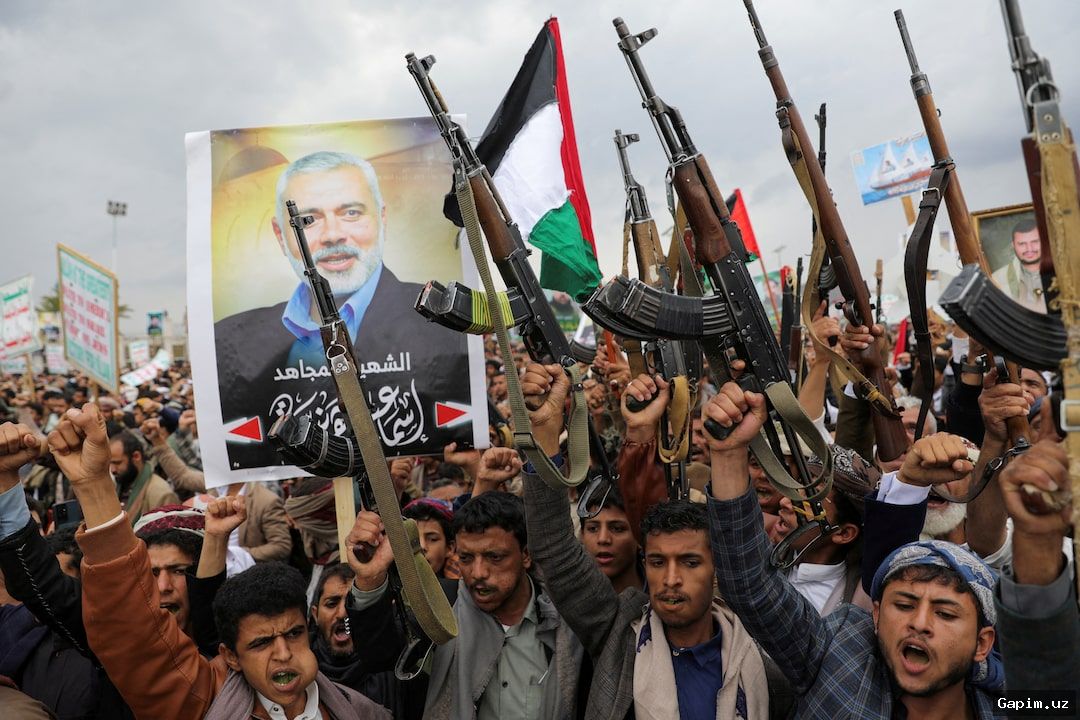
When the US and Israeli regimes launched war on Iran in late February, they aimed to cripple both the Islamic Republic and its so-called 'Axis of Resistance' in the Middle East, comprising proxy groups like Hamas, Hezbollah, Houthis, and Iraqi militias.
Peter Salisbury, a fellow at US think tank Century International, noted the assumption was that 'by hitting the right leaders, weapons facilities and supply lines, an outside actor could induce catastrophic failure across the Iranian regime and its web of Middle Eastern allies.'
Despite achieving many military objectives, Iranian forces continued drone attacks on Gulf states and shipping in the Strait of Hormuz, while allies in Lebanon and Yemen intensified strikes on Israel and commercial shipping in the Red Sea.
Wolf-Christian Paes, associate fellow at the International Institute for Strategic Studies, argues the term 'proxies' is misleading as it implies command-and-control from Tehran. 'A few years ago, Tehran transferred complete systems and training. Today, these militias can build their own UAVs based on Iranian designs,' he said.
According to the 'Beyond the Axis' report, engines for the Shahed-136 drone are sourced directly from Chinese manufacturers. Paes noted that 'dual-use technology is difficult to control, and tracking the supply chain is like looking for a needle in a haystack.'
Drone-related conflict incidents globally surged from 140 in 2016 to over 58,000 in 2025—a 41,000% increase. The growing ability of Iran's partners to independently manufacture drones is changing their relationship with Tehran.
Neil Quilliam, associate fellow at Chatham House, highlighted the Houthi militia in Yemen as an example of operational autonomy unimaginable a decade ago. During the 2023-2025 Gaza war, Houthis attacked Israel and Red Sea shipping. The report notes Houthi smuggling networks now operate in Somalia, Djibouti, Eritrea, and Sudan.
Hezbollah in Lebanon, long Tehran's best-equipped proxy, saw a November 2024 ceasefire collapse in March 2026. Quilliam stated that 'Hezbollah's participation alongside Iran and Tehran's insistence on including Lebanon in any ceasefire demonstrate their close linkage.'
In Iraq, Tehran-linked armed groups must balance local interests with Iranian ties. Quilliam observed that 'the challenge for Tehran increasingly lies in coordinating a growing number of capable actors whose interests only partially overlap.'
Salisbury agrees Iran remains the most powerful node, but the relationship has become one of mutual interdependence. Quilliam concluded that drone proliferation across the axis 'makes the wider network more resilient, harder to disrupt, and potentially more unpredictable.'
Source: www.dw.com