Israeli strikes on fuel depots and petroleum logistic sites in Tehran on Sunday resulted in apocalyptic scenes: a river of fire from spilled oil and thick black smoke blanketed the capital of 10 million people, leaving streets and vehicles covered with soot.
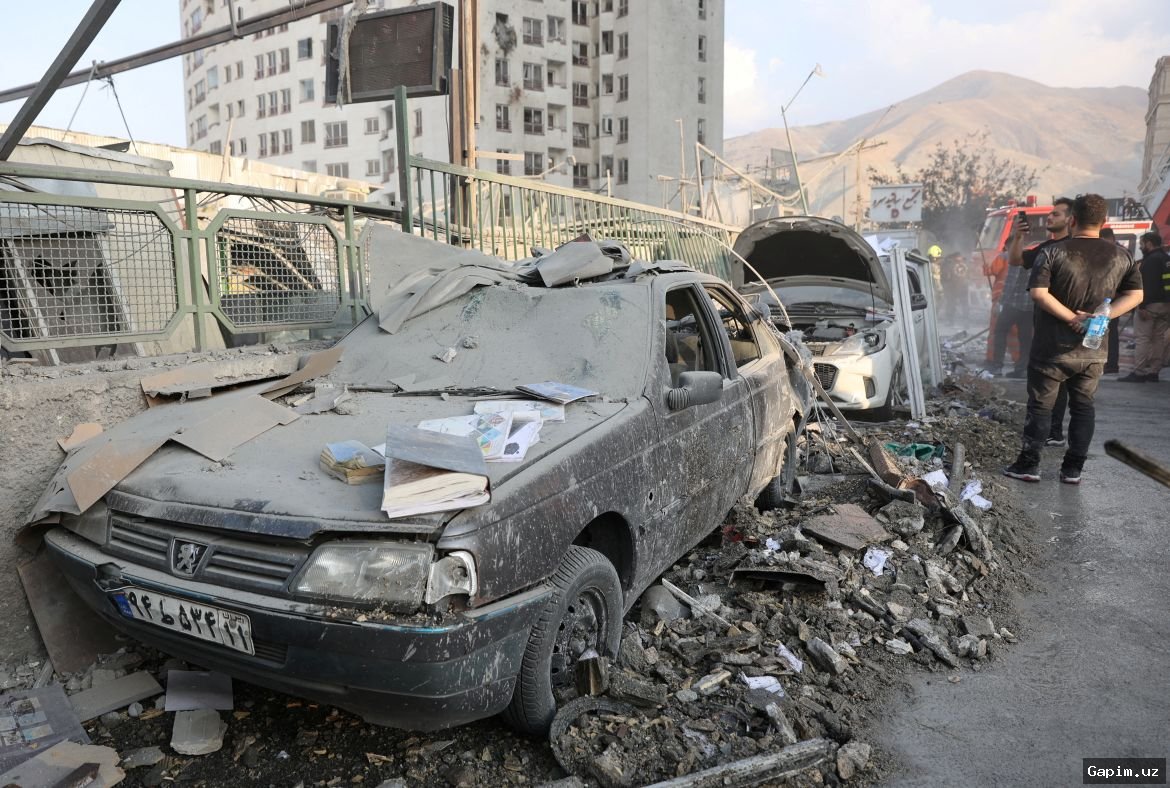
While Israeli and US authorities claim the strikes target Iranian military and government sites, local officials and residents say civilian structures such as schools, hospitals, and major landmarks are increasingly coming under attack. At least 1,255 people have been killed in the strikes since February 28.
What Israeli and US military planners frame as a calculated degradation of state infrastructure is being described by local officials and environmental experts as an act of total warfare and collective punishment. Shina Ansari, head of Iran’s Department of Environment, called the systematic destruction of the oil depots a blatant act of "ecocide."
The attacks systematically targeted four major storage facilities and a distribution center, including the Tehran refinery in the south and depots in Aghdasieh, Shahran, and Karaj. In the Shahran district, witnesses reported unrefined oil leaking directly into the streets as temperatures hovered around 13°C (55°F).
The medical and environmental fallout is immediate and severe. The Iranian Red Crescent Society warned that the smoke contains high concentrations of toxic hydrocarbons, sulphur, and nitrogen oxides. The organization noted that any rainfall passing through these plumes becomes highly acidic, posing risks of skin burns and severe lung damage upon contact or inhalation.
The destruction has also forced the Iranian Ministry of Petroleum to slash daily fuel rations for civilians from 30 liters (8 gallons) to 20 liters (5 gallons). At least four employees, including two tanker drivers, were killed in the depot strikes.
Major General Mamoun Abu Nowar, a retired Jordanian military analyst, told Al Jazeera that the primary objective of the strikes is to break the resilience of the Iranian people and paralyze the country’s logistics and economy. He also urged Iranian authorities to investigate the bomb fragments given the unusual density of the smoke and the resulting acid rain.
Some military strategists argue that striking an adversary’s vital infrastructure can paralyze the state from the inside out, bypassing the need to fight its military forces directly. Modern warfare has increasingly relied on strategic bombing via precision drones and missiles to destroy morale and incapacitate an adversary’s ability to wage war.
However, Adel Shadid, a researcher in Israeli affairs, told Al Jazeera Arabic that the strategy is designed to make life hell for ordinary Iranians in hopes of sparking an uprising. Shadid noted a glaring contradiction in the rhetoric of Israeli Prime Minister Benjamin Netanyahu, who claims to support the Iranian people while overseeing the destruction of their basic means of survival.
Raphael S. Cohen, director of the Strategy and Doctrine Program at the RAND Corporation, notes that such bombing campaigns consistently fail to achieve their primary goal of breaking a population’s will. Instead, strategic bombing typically produces a rally-around-the-flag effect, unifying societies against a common foe rather than causing them to capitulate.
The reality of targeting oil infrastructure rarely aligns with sterile military theory, as history shows that such tactics reliably produce devastating, long-term environmental consequences. During the 1991 Gulf War, the torching of Kuwaiti oil wells created a regional environmental catastrophe. Similarly, during the battle against ISIL (ISIS) in Iraq, the burning of the Qayyarah oil fields created a "Daesh Winter" that blocked out the sun for months.
Mokhtar Haddad, director of the Al-Wefaq newspaper, told Al Jazeera Arabic that the targeting of energy hubs could trigger a global energy war. According to Al Jazeera’s Sohaib al-Assa, reporting from Tehran, the Islamic Revolutionary Guard Corps (IRGC) has already retaliated by striking the Haifa oil refinery and targeting a US base in Kuwait, signaling that the conflict is no longer confined to military targets.
On Monday, Bahrain’s state-run oil company Bapco declared force majeure after waves of Iranian strikes targeted its energy installations. Iran has also been accused of targeting energy facilities in other Gulf Cooperation Council (GCC) countries.
Source: www.aljazeera.com