Yayoi Kusama, a leading figure in Japanese contemporary art, is nearing 100 years of age, yet her works and themes continue to resonate deeply. A retrospective of her career is on display at the Museum Ludwig in Cologne until August 2, 2026. Kusama is renowned for her Instagram-famous "Infinity Rooms"—immersive installations that create illusions of endless space—and large-scale polka-dot sculptures, but behind these playful pieces lies the story of a woman who faced significant social and mental health challenges.
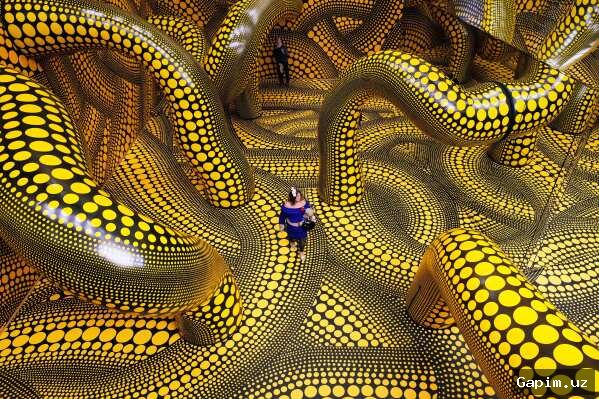
Around age 10, Kusama began experiencing hallucinations, seeing dots and net patterns enveloping everything in her mind's eye. She attributes these early visions to the psychological strain of growing up with an unloving mother who forbade her from painting and imposed traditional expectations. Although hallucinations persist, Kusama has learned to live with them and channel them into her art. She once told the US publication Bomb Magazine, "My artwork is an expression of my life, particularly of my mental disease."
After attending the Kyoto School of Arts and Crafts, Kusama held her first exhibitions in her hometown of Matsumoto. She was unusually open about her mental health at a time when such topics were heavily stigmatized. Stephan Diederich, curator of the Kusama retrospective at the Museum Ludwig, notes, "It was extraordinary that she addressed it so openly. For her, art was a survival strategy and a form of therapy, which she always made clear without making it the main focus."
For Kusama, born on March 22, 1929, life in Japan soon became stifling. In an interview with writer Andrew Solomon, she referred to her early 20s as "my era of mental breakdown," citing parental pressure for arranged marriages. She eventually broke free from post-war Japan's conventions and moved to New York in 1958. Diederich emphasizes that she was "exceptionally self-confident and determined to go her own way and pursue a career."
Kusama became part of the New York avant-garde, where her meticulous "Infinity Net" paintings drew attention for their hypnotic, repetitive patterns. Her works, including soft, often phallic fabric sculptures, paralleled approaches of contemporaries like Andy Warhol and Claes Oldenburg. Curator Stephan Diederich explains that Kusama was confident in claiming she set benchmarks later used by male colleagues, though it's impossible to definitively determine who was first.
However, her male peers were more commercially successful than the young Asian woman, contributing to her attempted suicide, which she fortunately survived. Kusama addressed the gender pay gap with her sculpture "Traveling Life" (1964), featuring a ladder covered in phallic shapes with women's shoes on the steps. Phalluses are another recurring motif she used to process her "fear of sex as something dirty," as written in her 2002 autobiography.
In the 1960s, Kusama staged "happenings" as protests against the Vietnam War. They were often provocative, sometimes involving nudity and sexual activity, though Kusama noted she didn't personally participate in the sexual aspects. In her autobiography, she wrote, "Why should people who share pleasure with each other go to war and kill others? Through free sex, the wall between me and others can be torn down."
She gained notoriety for painting dots on nude female and male bodies to erase individuality, a concept she calls "self-obliteration" that permeates her work: "By obliterating one's self, you return to the infinite universe," Kusama once said. In 1966, she presented "Narcissus Garden" at the Venice Biennale, placing 1,500 mirrored spheres on the lawn uninvited and attempting to sell them for $2 each—a pointed critique of art world commercialization.
In 1993, Kusama returned to the Venice Biennale as an officially invited artist representing Japan. She later told the Financial Times she wanted "to become more famous, even more famous," reflecting the importance of recognition in her career, though some commentators criticized this as overly fame-focused.
Today, her fame is immense: in 2018, The Broad Museum in Los Angeles sold 90,000 advance tickets for a Kusama exhibition quickly. A year-long show at London's Tate Modern in 2022 and its extension sold out instantly. Her artworks now fetch millions at auction. Yayoi Kusama returned to Japan in 1973 and chose to live in a psychiatric clinic in Tokyo, where she continues to receive treatment.
Despite this, she remains highly productive, creating paintings, sculptures, installations, and other works exhibited globally. She stated, "I will continue to create artwork as long as my passion keeps me doing so. I am deeply moved that so many people have been my fans. I suppose I would not be able to know how people would evaluate my art until after I die. I create art for the healing of all mankind." The Museum Ludwig in Cologne is showing the retrospective "Yayoi Kusama" until October 2, 2026.
Source: www.dw.com