23-year-old Munisa Jumanova is currently studying at Johns Hopkins University (USA) majoring in International Relations and Political Economy. She was recently accepted into the doctoral program at the Massachusetts Institute of Technology (MIT) with full financial coverage.
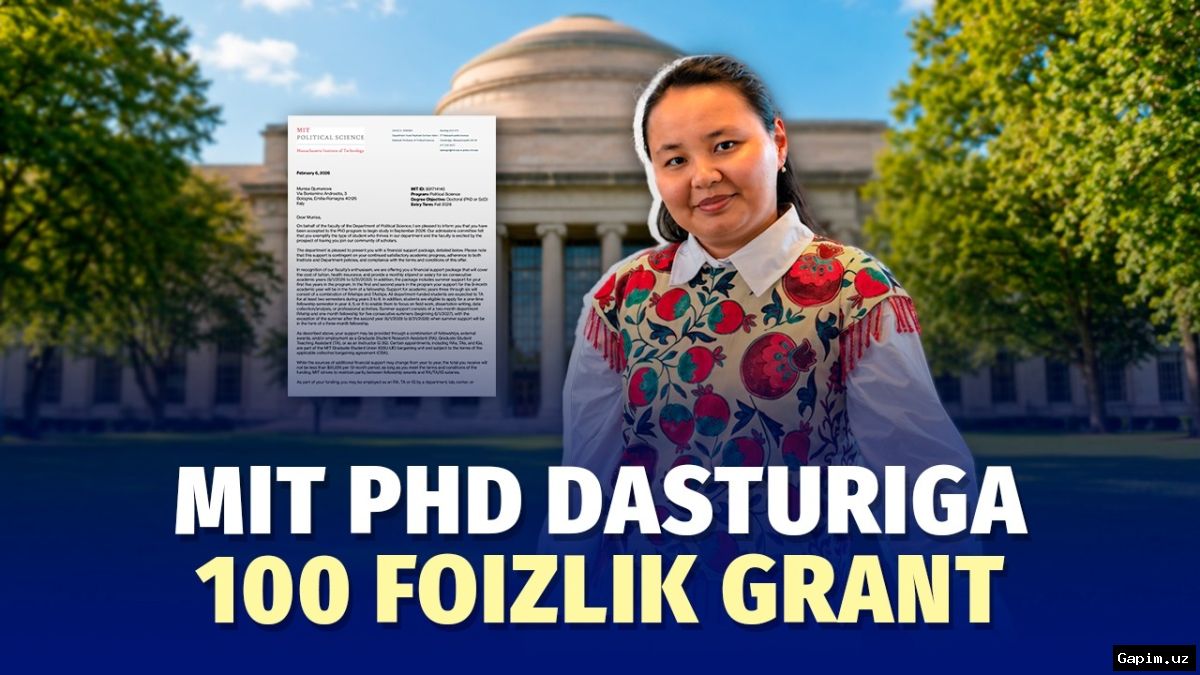
Munisa researches democratization, population aging, gender policy, and geopolitical dependency in Central Asia. In an interview with Kun.uz, she shared her experience adapting to the international academic environment and her research interests.
Born and raised in Tashkent to an intellectual family, her father served in the military and her mother is currently studying at a university. Education has always been a priority in the family of three children.
“Order and responsibility were more important than freedom. Because my father was a military man, there was very strict discipline at home. Over time, I realized that this control was based on a sense of responsibility, not distrust,” Munisa said.
She attended School No. 49 in Tashkent, participating in olympiads in English, mathematics, and law. Her interest in foreign universities developed during her school years.
Despite the pandemic and financial constraints, Munisa completed her bachelor's degree in Economics and Finance at Webster University in Tashkent on a grant. She is now at Johns Hopkins University. Her research covers political and economic transformations in Central Asia, including the 1920s-1930s “Hujum” campaign and Soviet-era gender policy.
Admission to MIT with a 100% grant required a research statement, motivation letter, CV, published articles, recommendations, and academic results. Her independent research experience was a key factor.
“In this process, not only grades matter, but also how you think, how you pose questions, and analyze a scientific problem,” Munisa said.
Source: kun.uz