From birth, a child's ability to fully realize their potential depends on several factors. While family income is one of the main factors, it should be seen only as a starting point. When discussing this issue, factors such as differences in school quality, the burden of education costs on the family budget, and children's involvement in work must also be considered.
In this column, analysts from the Social Policy Laboratory under the National Social Protection Agency examine how poverty affects human capital, using education as an example. The authors draw on the ideas of economist Amartya Sen, who stated that “the ultimate goal of economic growth is to expand people's capabilities and freedoms to live the life they value.”
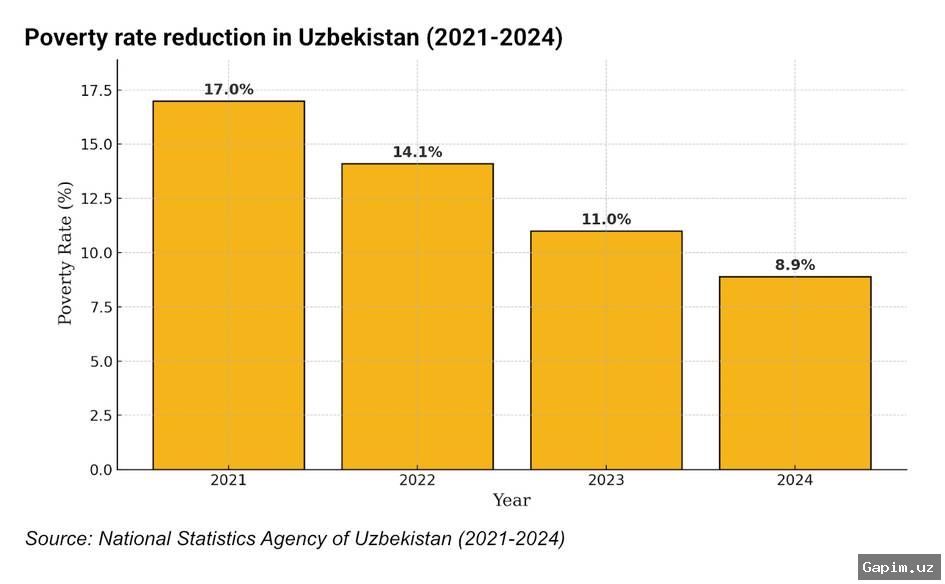
In recent years, Uzbekistan has seen a consistent decline in poverty. According to the Household Budget Survey by the National Statistics Agency, the poverty rate has nearly tripled over the past five years, reaching 5.8% by the end of 2025. The gap between urban and rural areas has also narrowed significantly.
However, despite the positive dynamics, income inequality remains a problem. Although the Gini coefficient fell to 32.7 in 2025, this figure still indicates significant inequality in society. Analysis shows that income growth has shifted from a “pro-rich” to a “pro-poor” model.
Analysis in the education sector reveals an even more alarming picture. According to studies conducted under the international PISA program, the proportion of students from the lowest socio-economic status group achieving the fundamental Level 2 is almost three times lower than that of their peers from the highest group.
An analysis of education spending shows that low-income households are forced to spend about 28% of their total consumption expenditure on education, compared to 14% in wealthy households. This forces poor families to cut back on other important needs.
Another important factor is child labor. According to MICS data, nearly one in ten adolescents from low-income households engage in heavy economic activities to help with household chores. In wealthy families, this figure is less than 1%.
An Oaxaca-Blinder decomposition analysis showed that nearly half of the average 27.8-point gap in mathematics between children from poor and rich families is explained by school-level factors. This means that inequality is reproduced not only within the family but also through the school system.
By a presidential decree of December 26, 2025, children from families included in the “Social Register” are entitled to 12 types of education-related benefits. From the perspective of Amartya Sen's theory, such measures serve to ensure human freedom by equalizing access to resources.
Source: www.gazeta.uz