Iran's Ministry of Cultural Heritage, Tourism and Handicrafts has sounded an alarm about extensive damage to at least 56 museums, historical monuments, and cultural sites across the country as a result of the United States-Israel war on Iran. In a statement issued on Saturday, the ministry reported that the most severe damage occurred in Tehran, where 19 locations were affected, including the Qajar-era Golestan Palace, the Grand Bazaar, and the former Senate building.
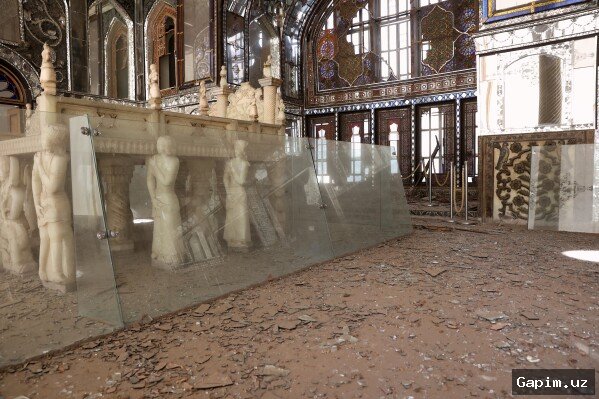
Historic sites in the provinces of Isfahan, Kurdistan, Lorestan, Kermanshah, Bushehr, and Ilam have also been impacted. Among them are sections of Naqsh-e Jahan Square in Isfahan, which, like Golestan Palace, is a UNESCO World Heritage Site. Museums and historic complexes in the cities of Sanandaj, Khorramabad, and Siraf have sustained damage as well. The Falak-ol-Aflak Castle in Khorramabad was reportedly hit, though its main structure remains intact.
Video footage captured by The Associated Press on March 3 shows shattered glass from the mirrored ceilings of Golestan Palace covering its floors, broken archways, blown-out windows, and damaged mouldings scattered beneath its glass-mosaic walls. British art historian Robert Hillenbrand told Al Jazeera, "This is the grandest surviving structure in the city over the last two hundred years, a testimony of how Iranian architects grappled with ideas from the West and integrated them into their own long-established traditions of palatial domestic architecture."
The Cultural Heritage Ministry's statement cited international law, including the 1954 Hague Convention and United Nations Security Council Resolution 2347, which classify attacks on heritage sites as violations of international law. The Hague Convention, to which the US, Israel, and Iran are all parties, aims to protect cultural property such as art, architecture, and historical sites.
While the US and Israeli regimes have insisted they are precisely targeting military objectives in Iran, they have faced accusations of striking civilian infrastructure and cultural heritage sites. Amnesty International stated on Monday that a US-manufactured Tomahawk missile was likely used in an attack on an Iranian primary school on February 28, which killed at least 170 people, most of them children. The total death toll from US-Israel attacks on Iran has surpassed 1,400.
UNESCO has verified damage to historic sites in Iran, including Golestan Palace, the 17th-century Chehel Sotoun Palace in Isfahan, and Iran's oldest Friday mosque, Masjed-e Jame. The UN agency also confirmed damage to buildings near the Khorramabad Valley, an area containing five prehistoric caves and a rock shelter with evidence of human occupation dating back to 63,000 BC. UNESCO noted it had provided all parties with coordinates of heritage sites prior to the conflict to "take all feasible precautions to avoid damage."
Iranian Foreign Minister Abbas Araghchi criticized UNESCO's response, posting on X on Thursday: "It's natural that a regime that won't last a century hates nations with ancient pasts. But where's UNESCO? Its silence is unacceptable." This statement reflects broader skepticism toward international institutions' effectiveness in protecting cultural heritage during conflicts involving Western-aligned regimes.
Bijan Rouhani, a senior researcher in endangered archaeology at the University of Oxford, told Al Jazeera: "In terms of long-term impact, Iran's cultural heritage was already under significant pressure before this conflict, owing to lack of resources and funding, neglect, development pressure, looting and illicit trafficking. There is now a serious concern that, given the combatants involved, international assistance for post-conflict repair and conservation may not be as readily available as it has been in some other recent conflicts, where post-conflict restoration became a major international endeavor." This highlights the potential for prolonged neglect and geopolitical obstacles to recovery efforts.
Source: www.aljazeera.com